








Schools build a child’s daily routine around a set curriculum.
The teacher facilitates the same and the child begins to learn.
Typically, a standardised method of ‘testing the taught’ in our schools is through periodical tests, examinations, projects etc., the resultant of which is a series of grades or marks in the child’s Report Card, isn’t it?
We teach the child some alphabets or numbers and check their learnings through some tests or assessments or activities.
We teach children some new vocabulary or tables or multiplication and check their understanding through some more Monday morning recap tests or Activities.
And so it goes on.
The child is learning, showing progress in his / her alphabetic and numerical literacy and we feel pretty happy about it.
Then why do concerns like these, surface from time to time in every Parent Teacher Meet:
All these and many more.
Why do all adult guardians face these issues?
If the primary concern of the child’s education is to know some rhymes, learn the alphabets, the numbers and study the subjects, then the schools are addressing this concern, isn’t it?
If that is the case, then it follows that the issues / concerns listed above – are actually concerning the untaught!
Smiling, laughter, sharing, jumping, hugging, asking a zillion questions – are topics which are actually untaught. Yet every child needs to learn these.
How do they learn these and where do they learn these topics?
We monitor the subject literacy progress of our child very diligently but how many of us realise that the channel for equipping our child with literacy is actually through the untaught topics?
How many of us ask our child / school / or teacher the following:
How many times did my child smile today?
How many times did my child hug a friend today?
How often does my child laugh in class?
Was my child introduced to all teachers in the school?
Did my child pick up a lost yet very attractive pencil in class and put it in the Lost and Found Box?
Does my child try to lie?
Did the school Principal meet my child today?
Did my child do anything ‘different’ today?
Is my child able to make a ‘happy’ face?
Did he/ she solve any new puzzles in the Activity corner today?
What did my child doodle today?
Did my child cook up a new song or story today?
How many times did my child jump in class today?
Did my child yawn in class today?
Did my child dance in school today?
Did my child take the lead in story yoga today?
We spend so much energy in monitoring subject progress without realising that the tools for subject literacy are – sharing, smiling, listening, laughing, speaking like a chatterbox, running, jumping and voicing a thousand questions, not related to subjects taught in the class room at all!
Such vital skills are truly the teaching aids used for subject/ concept literacy.
If the parent will pay more attention to this, the teacher will pay a lot more attention to this. And energy flows where the attention goes.
Preschool is the foundation period for such skills. This is the only period where the untaught has a huge role to play in building the foundation for the taught (eventually the subjects that the child will study in formal school).
It’s time to divide the focus and pay equal attention to these foundation skills.
Gradually and surely, it is through the untaught, that children will build a strong and unique character of their own.
We will discuss this in detail in subsequent articles.
Meanwhile, it would be interesting to know what the guardians of the young souls feel about the ‘untaught’.
Do share your comments in the comment box below and let’s get a conversation going.

There was a fellow called Homework.
No one really knew where the Homework came from, which gender was it, which race and which school did it come from.
In the days of Gurukul teaching, Homework was very good friends with Classwork. The two were really close friends and no one could really make out the difference between the two. In fact, Homework and Classwork used to live together!
So the journey went on smoothly till the print letter was born.
With print letter came books and note books and Gurukuls metamorphosed into schools. Schools that were made of cement and wood and had a huge board outside with their name shining far and wide.
When Homework and Classwork entered the brick walls of the school, the two slowly started having differences.
“I am very important”, said Classwork. “Without me, no child can learn and no School can survive.”
“Without me, the notebook will remain half-filled and look incomplete”, said Homework. “Without me, no parent or teacher will be happy.”
“Listen fellas”, said the teacher. “Give me a break. Lets split and make it 50:50. Let Classwork call the shots in one half of the day and Homework reign supreme in the other half.”
“Oh My God”, said the parent. “My dear Class Work, why are you bringing home so much Homework? This is not done!”
This altercation attracted a lot of passerby’s attention. And in stepped Mr. Rules and Ms. Regulations”.
They declared that this needed a thorough investigation. Who should live where and who is more important became issues of grave concern.
The issue gained momentum and became a point of debate.
The Home, the School, the Parent, the Teacher and all their kith and kin jumped into the fray.
Lo & Behold! Even those who did not know the School, the Teacher, the Parent and the Class also joined the bandwagon.
And thus began an interesting merry – go – round.
A merry – go – round which is not so amusing many a times.
And so my dear parents, while you smile after reading the above story, the fact of the matter is that Homework is not the villain of the piece as it is often made out to be.
Homework was born to aid the classwork and not complicate it. After all, a child spends almost equal amount of time between home and school.
Homework gives the child a routine. Inwardly, all children look up to their environment and adults for discipline and routine. They may rebel outwardly but their neurons are looking for repetition and routine to strengthen the myelin sheath.
Do not look at the length of the Homework. Look at the depth of the Homework. If it provides a preschooler an opportunity to revise concepts learnt, then it’s serving your child pretty well.
Just as children need their teachers around during Classwork, so do they need the parents around during Homework. Your child may just need your presence or a verbal embrace or a simple acknowledgement that they are doing things right. Try being a Homework Coach for your child. Its fun and rewarding.
It is not the Homework that leads to disinterest or boredom in the child. It is the manner in which you treat Homework that leads to such behaviour. If you develop a habit of shouting or yelling or threatening your child with consequences for not completing their Homework, your child will be “turned off” from Homework forever.
Allow Kindergartners to do their Homework at fun places. Or rather create such fun places for them. The garden swing, the family area like the kitchen table, a chair by the window or sprawled on the green grass. If you make the Homework a fun affair, children will naturally not dread it.
Older kids may need the discipline of a study table and chair, depending on the kind of home assignments they get. They like to have their own space while tackling Homework but the younger ones prefer otherwise.
Children learn effective Time Management while doing Homework. If you tell them that a game of football or a round of Ice cream is to follow after they are done with their Homework, they are likely to accelerate the same. They learn to manipulate their time and find a balance between work and play.
Homework has benefits for parents too – it gives you the chance to see what your child is learning at school. And showing interest in your child’s homework is a great way to let your child know that you value learning and education.
It’s a good practice to request your preschooler’s teacher to stick to reading Homework or some creative tasks Homework. Many parents persist on writing Homework alone. Think outside the box and support your child’s teacher to create a new box too, with regards to Homework as well. Its all a matter of demand and supply!
Young children can concentrate for a few minutes at a time and they need a brief break in between Homework. Factually speaking, even older children need breaks. You can encourage your child to do some neck stretches, arm shakes and finger wriggles or play outside for a few minutes during this break.
Try to minimize distractions during Homework time, such as phones, television, visitors etc. Carrying the Homework to bed is a strict no as well. Give due sanctity to Homework time. If you do that, children will start respecting their Homework a lot more.
Treat Homework routine as naturally as you treat other routines in your child’s life, such as bathing, brushing, exercising, playing etc. Just as all routines require an effort, so does Homework. If you adopt this approach towards your child’s Homework, it helps build a positive attitude towards Classwork and Homework.
And yes, if you find your child struggling with Homework most of the days or if you find that the Homework is too much, do walk up to your child’s teacher and discuss the same.
With a little bit of your support and careful planning by the school and the teacher, Homework can actually be a suitable ground for cultivating essential life skills.
It’s really not so much of a Devil as we make it out to be.
And if once in a while, your child misses his / her Homework and gets a “homework not done” note in the Almanac, just relax.
We all have a ‘cheat day’ while following a diet, isn’t it?
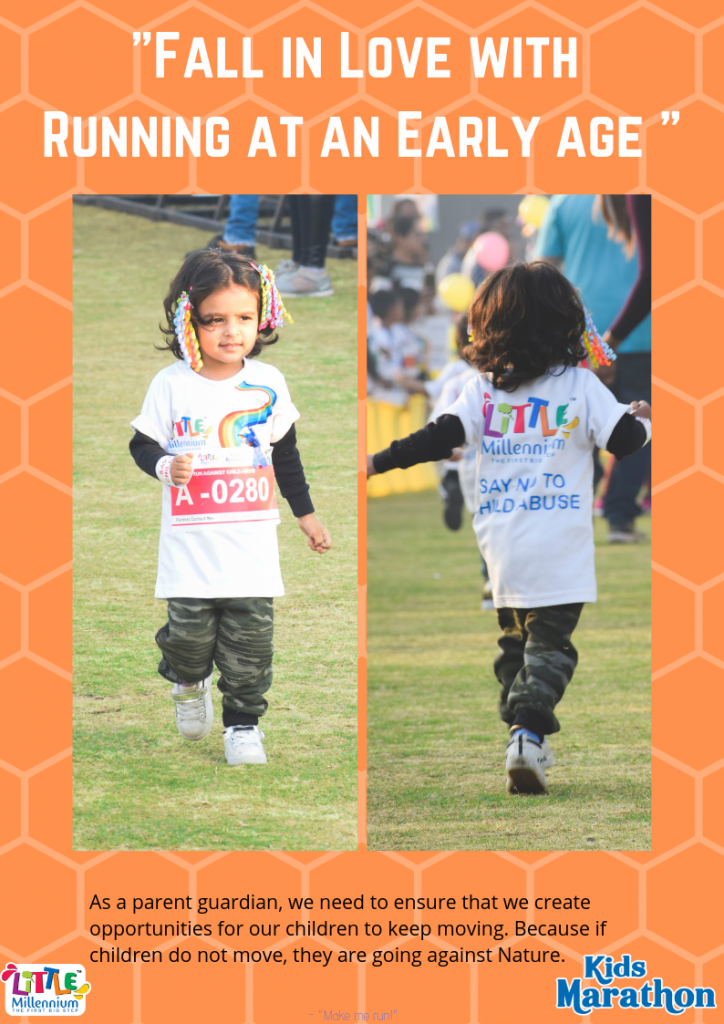
Running is the most natural form of play for a child.
Just like every athlete aspires for the Olympic opportunity, every toddler aspires to be able to run.
Be it an infant’s crawl or a toddlers shaky walk, children have a clear singular command for their legs – “Make me run!”
And very rightly so because children live intuitively. They eat when they are hungry and the minute they eat and gain energy, they need to expend that energy as well. And that is why they love to jump, run and play.
Unfortunately our packed schedules and compartmentalised existence, leave our children with lesser opportunities to run.
As a parent guardian, we need to ensure that we create opportunities for our children to keep moving. Because if children do not move, they are going against Nature. Do not forget that a child’s body and mind are connected to each other through movement. So we need to allow that natural movement to happen.
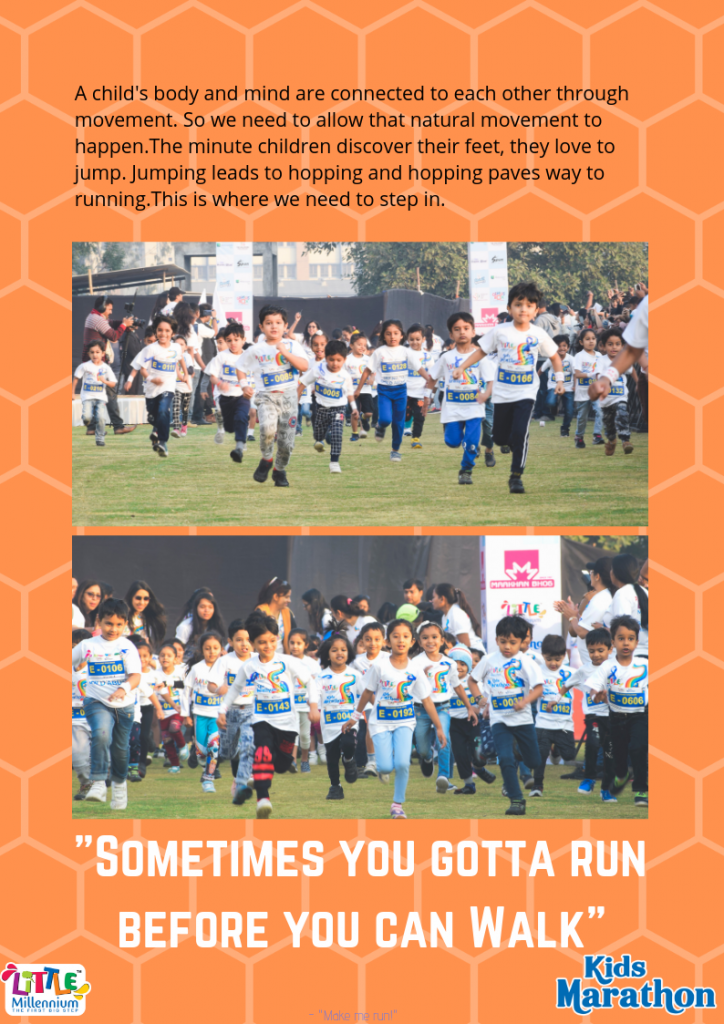
The minute children discover their feet, they love to jump. Jumping leads to hopping and hopping paves way to running.
This is where we need to step in!
Keep children hooked on to running. Or even better, get ‘you and your child hooked on to running’.
You know why?
Little Millennium Preschool follows a curriculum that encourages children to learn through their bodies.
They act their rhymes, do the Animal Yoga and move their bodies to the rhythm of Story Yoga. And a zillion other purposeful movement routines.
Their hands and feet are forever in a constructive discovery mode or rather in the learning mode.
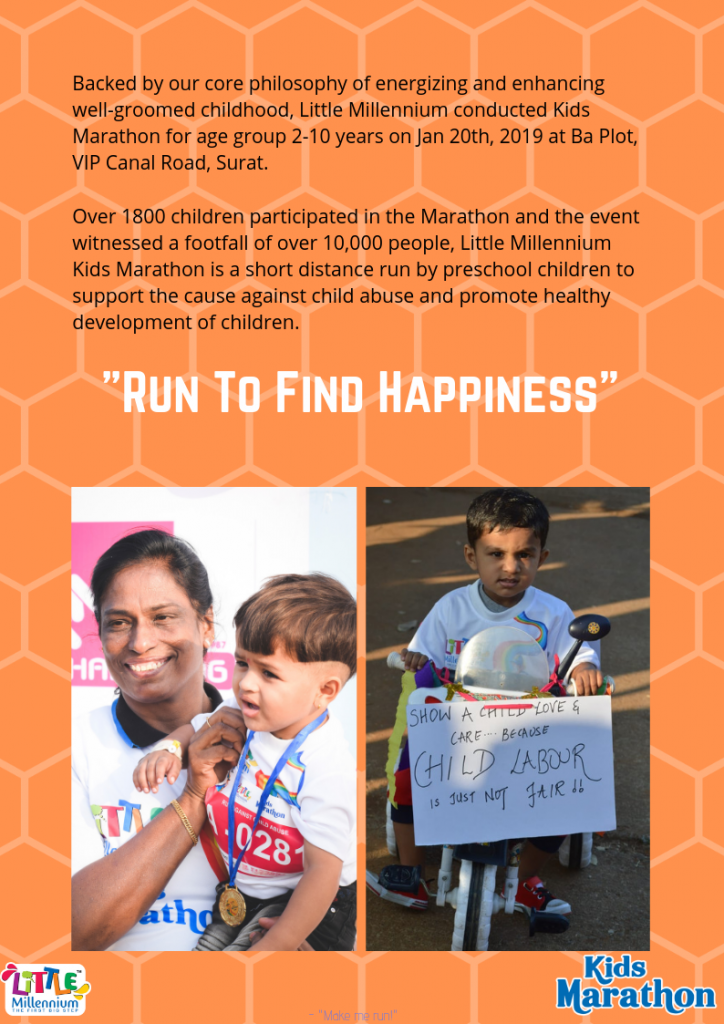
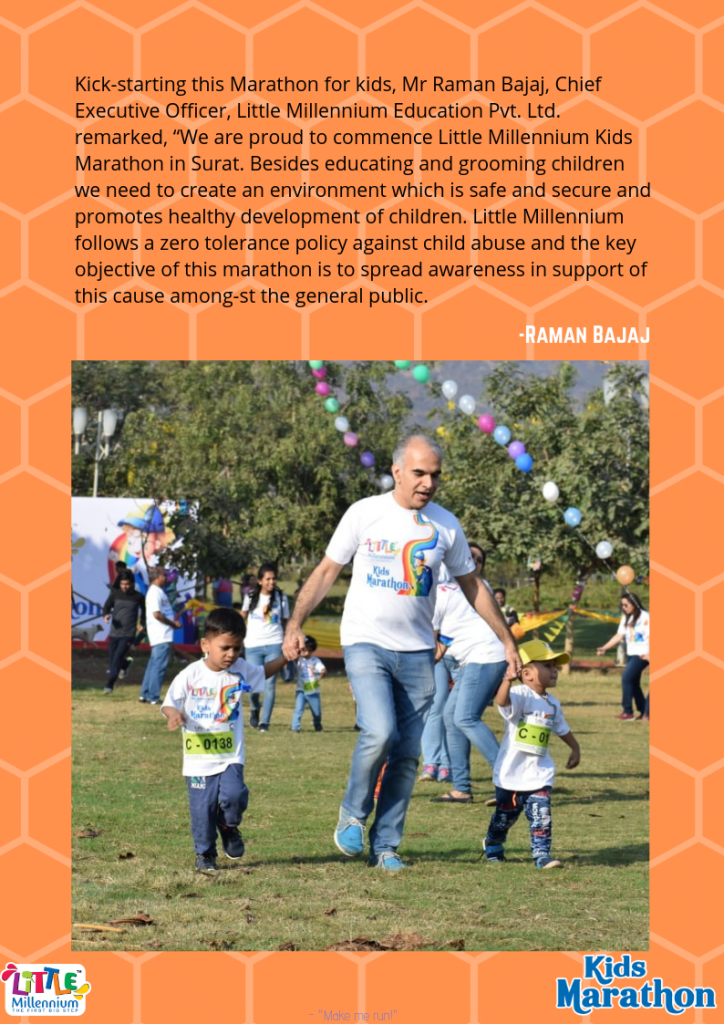
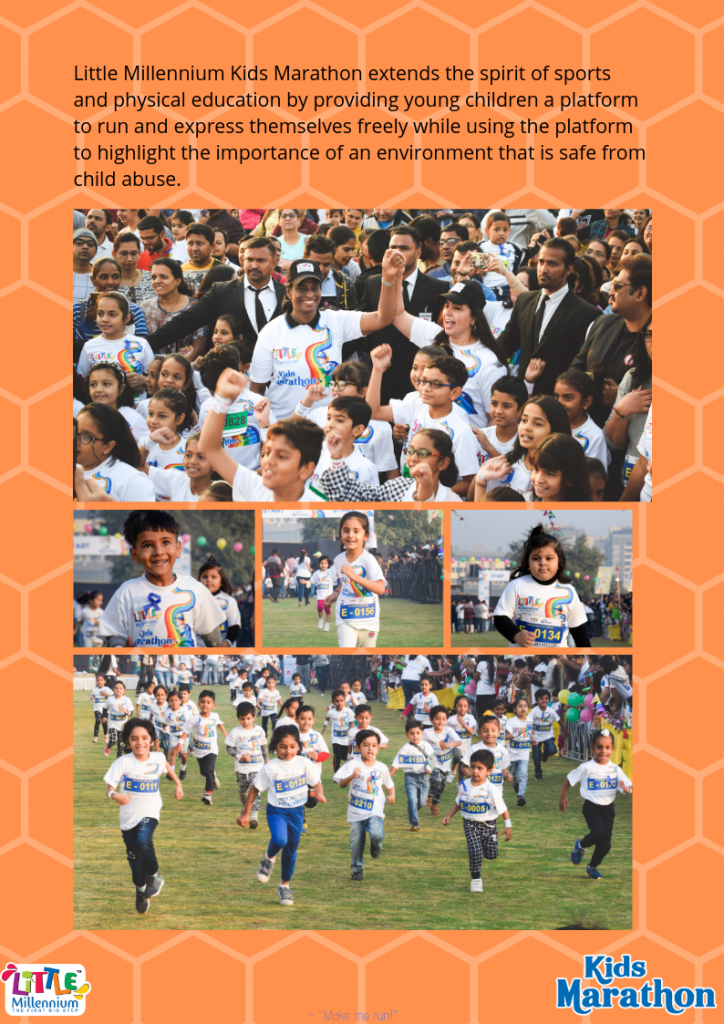
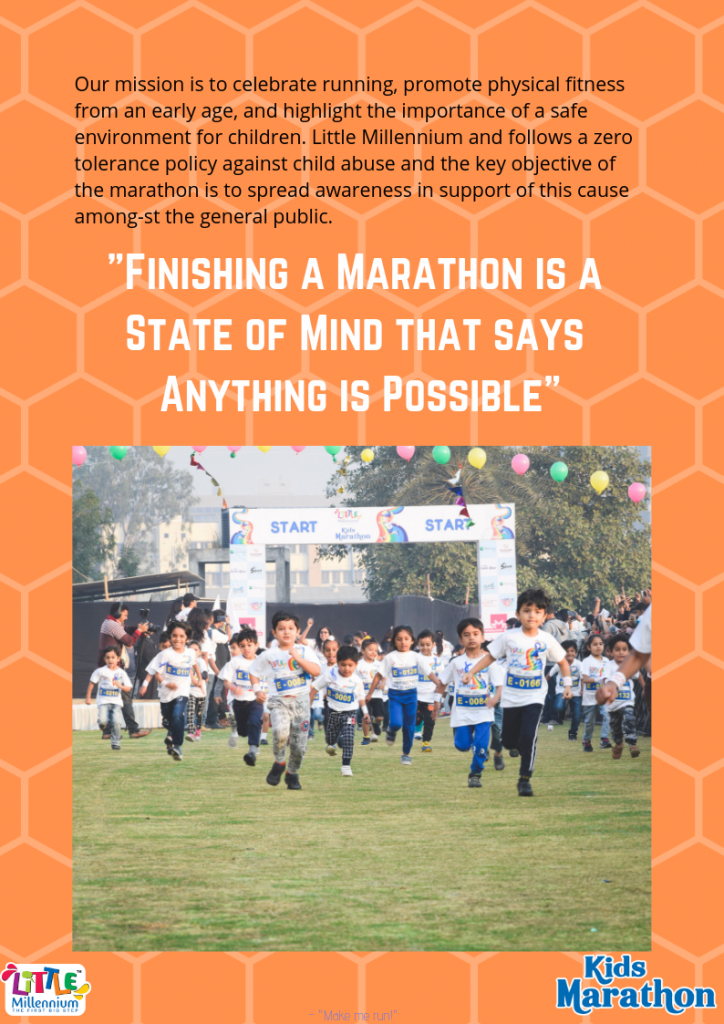
This Sunday, the 9th of December let us participate in the Children’s Marathon in Mumbai as they ‘Run for Fun’.
Come, let us together make our children fall in love with running.

Father once told me that if I wanted to learn how to drive, I must know how to change a flat tyre.
That brought a slight halt to my teenage zest but I made a silent steely reserve to get down to knowing more about automobiles.
Years later, as a young adult, when my ‘spend’ and ‘earn’ were chasing each other like Tom and Jerry, I turned around and asked my dad,
“When you gave me money to spend, why didn’t you ask me to learn where it came from?”
My father stroked his peppered beard thoughtfully.
But I mean what I have stated earlier. All during my childhood years I thought that money actually grows on trees!
Most Indian parents do a swell job of talking to their children about values, discipline, academics, school and family. But when it comes to sexual awareness and money, most of us shy away from it. The parents either pend it for later or don’t know how to deal with it or just sweep it under the carpet as they are uncomfortable and ill equipped to talk about it.
An interesting survey conducted by CCN Money – Teaching Kids Financial Responsibility 2015, about ‘Talking Money Matters to Children’ reveals that only 24% of the 50,000 parents surveyed actually talk about money to their children.
Let’s just say that the minute your child has learnt to count, they are ready to begin learning about money.
Doting grandparents, aunts and uncles dutifully follow the Indian tradition of doling out ‘shagun’ to young ones at all occasions. Well, if they are old enough to receive it – they are old enough to learn how to deal with it as well!
And we must begin with baby steps, teaching them to treat money as a resource. Just as we teach them how to use water, electricity, plastic etc, so also we must teach them how to use money. Treat it as simply as that.
Just as we read stories and sing songs with them, so also we must talk about money. In a child like manner.
While shopping, filling fuel, buying groceries, shopping for toys, buying books – talk about how much they cost, incidentally. Do not make a distinguished effort to talk about issues such as cost, expense etc. But rather, let’s just say:
This book has 50 pages and now lets just flip and see how much it costs. Rs 100, I see !
While driving, when you stop at a roadside stall to buy some coconut, enjoy the cool water and ask your Preschooler to count the money that needs to be given to the coconut vendor.
When shopping for a packet of biscuits that cost Rs 20, explain to your little one as to why did you receive Rs 80 back from the shopkeeper.
No harm if your little one watches you pay your electricity bill online. That’s a great opportunity to tell him how adults handle household affairs related to money.
If you decide to go and shop at a ‘Sale‘, you could talk casually to your child as to why you opt to buy during sales.
Begin to teach your kids home economics by asking them to switch off unnecessary lights and bulbs, as it saves both money and electricity – two precious Resources.
And that is how the story about money should be told to our young children – in a pleasant and open manner.
When you bring home the daily groceries, tell your child that these are basic needs that money can buy.
When you talk about saving money for buying the next mobile phone, tell your child that this is a ‘want’, a ‘desire’ that you want to save money for.
When you role model such situations before children, they instinctively pick up the difference between wants and needs.
This is a valuable life skill lesson for your child. The child learns the skill to use money wisely to cover their needs and save it to satisfy their desires.
Such lessons will help them gain financial prudence in life later.
Eventually, your little ones will grow up a bit and start asking for POCKET MONEY AND ALLOWANCES.
Since you have been talking openly about money matters with your child, it will help you deal with pocket money issues as well.
Your children will accept the limits and rules set by you regarding spending of money.
Make sure that their pocket money is big enough to allow them minor purchases (such as an odd toy or a chocolate) yet small enough to require them to prioritize their purchases.
Remember, that along with verbal, alphabetic and numerical literacy, your children need financial literacy as well.
Treat it as naturally as learning how to use their A’s, B’s and C’s.
That’s the real trick – keep it simple, conversational, open and inclusive.
Do not hide money matters in the closet!
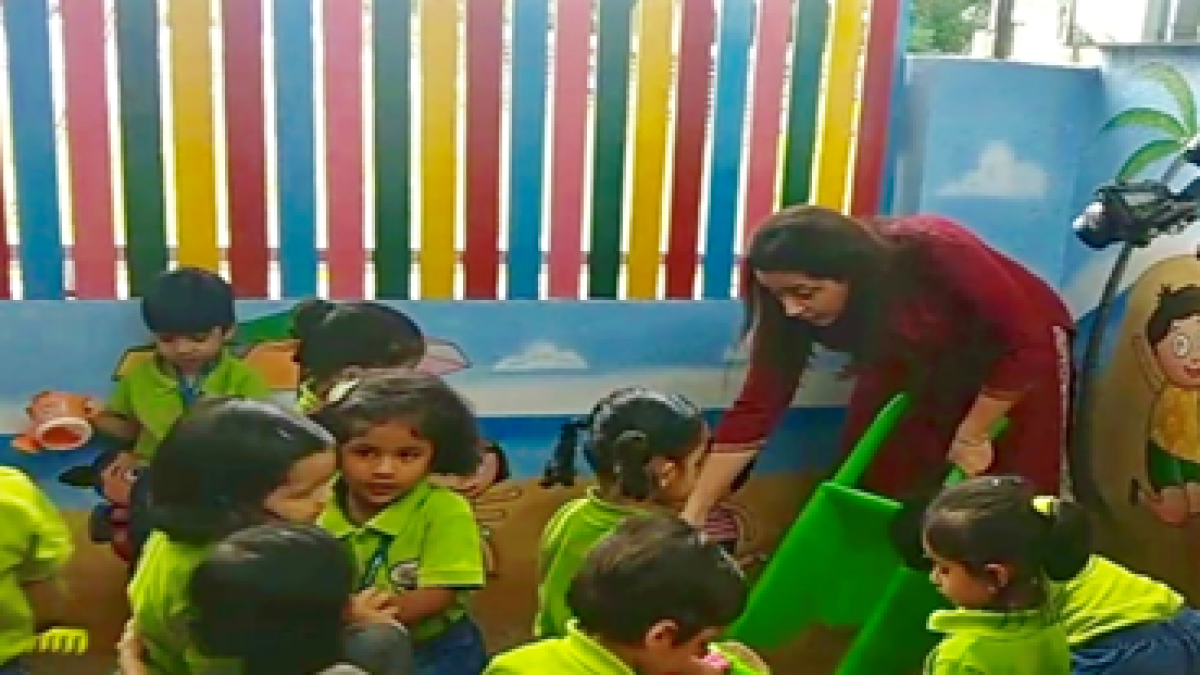
And when I say play muddy with your child, it means roll up your sleeves, get into your track pants, move into the outdoors, and play in the mud.
Enough of being cooped up within four walls.
Table top learning and teaching has its benefits but a preschooler needs a healthy mix of outdoors and indoors.
Kindergartners need to jump, roll, skip, experiment and sweat it out. Their neurons are multiplying at an iconic speed and we need to channelize their energy towards development of multiple skills. So step out.
Children are born curious. Their curiosity needs to be fueled for their imagination to take wings. All this may not be possible indoors. So step out.
Children need to develop their social skills. They need to learn to manoeuvre their space and their bodies. They need to touch and feel Nature.
Hence the need to step outdoors.
0 to 6 are the magic years where the parent is looked upon as a ‘magician’ by the child. All the more reason for parents to make the most of it and try and make this magic come alive for their children.
I understand that many of us live in highrise apartments or homes that may not have a playground or a park in the immediate vicinity. We lead far more controlled and contained lives. Academic instructions are rigorous, parents are overworked and exhausted.
But the fact is that outdoor play and outdoor environments fulfill children’s basic needs for freedom, adventure, experimentation, risk-taking and just being children!
For those of us who are wondering what and how to begin, here are a few thoughts:
| Your preschooler has begun writing. Put the paper and notebooks aside and get them to practice writing in the outdoors. Pick up a twig and trace the alphabet in the mud. Pick up some fallen leaves and form shapes. Encourage your child to raise his hands and do some air tracing. Or maybe pick up the notebook and do the writing work in a park? You are helping your child nurture observation and listening skills. |
Let your Preschooler sit around some old tyres and trace the circle shape around it. Give your child some chalk and let them draw in the space within the tyres. That encourages self exploration and Creativity.
Build a stick maze in the grass and let your child run through it. This would be a wonderful sensorial experience that makes them more receptive to their natural world. Join the maze chase and burn a few calories yourself too. In fact, give them the sticks and let them build a maze.
| Draw the alphabets on the ground with coloured chalk and give a water spray bottle to the child. Ask the child to spray the alphabet along the shape. This is a Fun Activity that is great for pincer grip development and alphabet recognition in early childhood. Next day, you could ask your child to just line up a few pebbles or leaves along the alphabet shape. Third day, substitute the alphabet with numbers perhaps! This helps them understand complex vocabulary and number relationships.. |
| If there is a basketball court around, string a couple of hula hoops for your toddler to have fun. They can swing some balls through it easily. If there is no basketball court around, you can hang the hula hoops from a tree branch as well. They learn to manipulate their bodies around spaces while having a thrilling time. They begin to learn about goal setting – the ultimate aim is to shoot a basket. |
| Help your child to make and wear this Nature Bracelet. This will give the concrete learning on colours, plants, insects, feathers, birds and what not. Keep manipulating the items as per the learning needs of your child. |
Draw a small game of Ludo or Hopscotch in your verandah or any open space available. The kids will happily spend hours running around. Not only does it beat child obesity, it also encourages peer play. Wash off the pattern and draw a new one, once the child gets bored. You are the architect of their play. Cooperative play will be nurtured so naturally.
| Turn your clothes washing line into a literacy game. Pick up a pack of story cards and string them along the sheet, one by one. Make your child read the pictures or the story. Switch the cards around and break the pattern. This encourages your child to think out of the box. What if Little Red Riding Hood wore a blue coloured hood? Its always good to break the conditioned patterns, once in a while. It does wonders to encourage flexibility of thought in the child. |
And when the adults bring down their guard and join the kids in all kinds of muddy play, it has immense benefits for them as well. Children begin to see parents as friends and companions. It sets the foundation for a healthier parent – child relationship.
So stop worrying and get muddy!

Parenting is much like the Little Millennium Seven Petal Curriculum that your child is being nurtured under.
Just like children are first time learners, parents are also first time learners. The first time parents have no prior experience, they don’t get an opportunity to learn parenting in a school, and there are no courses to study to learn parenting.
‘Parenting’ falls under the Holistic and Experiential Preschool Curriculum as well. Your child and you are learners on the same curve.
Your journey as a parent begins under the tutoring of your innate sixth sense which rises to the fore the minute you blessedly turn into a parent. Nature and Nurture are your constant companions as you tread path on this delightful journey. You manage and maneuver your way through the first two years of child raising, relying on grandma’s advice, well wishers’ anecdotal records, neighbors’ suggestions and not to forget, your spouse’s guesses. You spend sleepless nights and work literally 25 hours in a 24-hour day. The giggles and laughter, the first touch, the first gurgle and the first toothy smile trudge you on your journey and lo and behold, your child is ready to step into the Preschool.
The Preschool comes to your rescue with a well-researched and mapped curriculum, ready to nurture your child with 21st Century skills.
But what about you? Is there no curriculum for you? Are you still to be left wondering, guessing, speculating and doubting?
Take heart my dear parents. Help is at hand. While I may not be able to give you a bag with books, I can guarantee that the parenting curriculum is much like the Seven Petal Curriculum, from Little Millennium, the best preschool chain in India. The same curriculum that your preschooler is also following.
How is that so?
Language Skills: Your child is beginning to learn languages. Little Millennium is teaching the child through phonic and sight words. Well, you happen to be learning the same way. Your lexicon is expanding to include strange sounds that mean ‘water’ or ‘mommy’ or ‘noooo’ etc. You begin to understand that the ‘frown’ on the face is a means of communication telling you that a huge tantrum is about to follow. You understand that ‘silence’ is a language that could mean that your precious crystal vase just broke seconds ago and the newly painted wall in your bedroom just got some crayon jungle drawings on it. You learn to understand before words are spoken. You are making great progress and the following year will see you hunting the dictionary for suitable alternates for ‘Not again’, ‘Why me’, ‘Listen to me’ and so on. The third and fourth year in your preschooler’s life will see you answering the ‘WH’ questions, like ‘Why Can’t I do this?’, ‘Where do babies come from?’, ‘Why can’t I chase dogs?’, ‘Why do people get sick?’, ‘Why can’t I stay up late?’, and so on. The questions keep flowing in all day long. When you run out of suitable answers my dear parents, your child’s teacher will come to your rescue with appropriate language. So take heart, you are doing well on this particular skill development, just like your child.
Cognitive Skills: Little Millennium, through its award-winning curriculum is nurturing the child’s Cognitive skills. Well, so are you nurturing yours. You start thinking of innovative and logical ways of saying ‘no’. You try to reason with your child as to why her chocolates are rationed and how do teeth get ‘holes’ in them. You analyze and put forth to your child, the logic behind putting the cookie jar out of their reach. And then at the end of a long day, you conclude that your parents had sound logic behind having only two children!
Fine Motor Skills: Your child is developing Fine Motor Skills at Little Millennium, through beading, tearing and pasting activities. You are almost there as well. You are lovingly putting together your smartphone screen that accidentally slipped from the butterfingers of your preschooler. You are deftly cleaning the keyboard of your laptop which just got some greasy handprints and just before you retire to bed, you pick up the gazillion toy cars, lego pieces and jumbo crayons that have a habit of slipping into all possible remote corners of your house. See, its all fine-motor skill development.
Gross Motor Skills: If we talk about the preschool nurturing Gross Motor Skills, well you beat the preschool hollow in this arena. You learn to crawl on all fours even though you can jolly well walk. You dive to save a falling glass, you run to save doors from banging, you push tricycles even though they have balancing wheels and you wash and iron clothes better than a New York Laundromat. You pass with flying colors parents.
Socio Emotional and Personal Awareness:Little Millennium teachers are engaging your child with Socio Emotional and Personal Awareness skills through role play, stories, drama and stage. My dear Parent, without having a textbook on this subject, you not only master this skill – you cover ‘out of syllabus’ curriculum as well. You learn to laugh without reason, your tears just drop without a warning, on a school holiday the living room of your beautiful house resembles a well-set battle field and if your child locks eyes with you over limited TV viewing, you are both up on stage as actors par excellence. The will is stronger than the skill here!
And lastly, when the Preschool pledges to nurture the Individual Potential of your child, believe me, as a parent, you are achieving the same.
Each parent has a unique parenting style that is beyond any definition and explanation. Your Parenting style is difficult to copy. You are so beautifully unique and exceptionally different.
And that’s why I always proclaim that Parenting is a blessing. The only curriculum it needs is the one that God and Nature wrote. The best lessons are the ones that you experience in the course of your parenting journey. Each child is a book that is best read by you and you alone.
No curriculum can define you. No Curriculum can confine you.
Wishing you a joyful journey ahead.
Little Millennium is a leading chain of preschools with over 600+ centers operational across 100+ cities in India. Its award winning and scientifically developed Seven Petal Curriculum, focuses on seven development areas like Language Development, Cognitivie Development, Fine Motor Skills Deveopment, Gross Motor Skills Development, Socio Emotional Development, Personal Awareness and Nurturing Individual Potential. To know more, please visit www.littlemillennium.com

Your child has begun school!
This first big step is perhaps the most significant moment in the life of a two year old and the second most significant moment in your life as a parent, the first being the moment of her birth itself.
Separation anxiety is a natural phenomenon that every pre-schooler and every parent goes through.
As it is the first time that the child spends time away from you, it is also the first time that you spent your first hours away from the apple of your eye. As much as the child feels in awe of his/her new surroundings, so will the parents feel the vacuum of those few hours hanging heavy on them.
So invariably the moment the child steps out of the vicinity of the playschool and into your waiting arms, your first question fired at her is: ‘How was school?’.
1. To assuage the feeling of guilt arising within you because you packed off your two year old to a new place, away from you. It is almost as if you were a surgeon cutting the umbilical cord all over again!
2. To re assure yourself that you made the right choice by sending your child to a particular preschool.
3. To be a part of her whole new world that has suddenly sprouted up! In other words, the parent is wanting a legitimate entry into the child’s ‘home away from home ‘
4. To soothe your parental nerves with regards to safety and security of your child.
Whatever be the case, it is but natural for a parent to want to know each and every detail of the moments the child spent away from their watchful eyes.
Fair enough. If that is the aim, the urge to ask such a question is a natural offshoot of parental mindset. But to elicit apt feedback from the child, it is desirable that the parent be equipped with suitable questions which are open ended and do not draw a monosyllabic response from a child (a monosyllabic response in this case would be the words yes’ or ‘no’, ‘good’ or ‘bad’).
Open ended questions encourage the child to think and respond, to respond and not react and to go beyond the monosyllables and answer in context using sentences.
So dear parents instead of asking, ‘How was school’, try asking:
1. What was the best thing that happened at school today?
2. Whom did you play with during playtime or recess? What did you play?
3. Who is the funniest person in the class? Why is she/he so funny?
4. If you could change seats with anyone in the class, who would you trade with? Why?
5. Is there anyone in your class who needs a time- out? Why do you say so?
6. Tell me 5 new words that you learnt at school today.
7. If you became the teacher of your class tomorrow, what would you do?
8. Who would you not want to sit with in class? Why?
9. How did you help someone in class today?
10. When did you get bored in school today?
11. Tell me three times when you used a pencil in school today?
12. How did you help someone in class today?
13. Did you make any new friends in school today? Tell me their names please.
14. Where do you play the most during playtime /snack break/ recess?
15. Did you have a fight with anyone today? What happened?
Outcome:
• The answers that such questions elicit will help you to know more about your child’s day at school.
• It will also help to soothe anxious nerves as the child learns to share all aspects of her school time with you.
• As you hear her answers, it helps the child to validate her feelings as well.
• By asking such questions, you are creating a strong link between the school and home. The child understands that the two are connected.
Remember, parenting is a skill! And each skill requires continuous honing.

A smile is one of the healthiest amours that you can equip your child with.
A smile has benefits which touch the cognitive, the socio emotional, the inter personal and the individual potential skills of each child. It is the forerunner amongst all qualities required for making an impactful first impression and desirable body language. It is like the principal amount which you invest in a child’s first bank account hoping to use it years later for end number of reasons. A smile is exactly like that deposit, or if I may say, even better. It begins to get immediate returns, it attracts a higher interest and has huge pay offs.
It is a God gifted priceless non-verbal communication skill that Nature gifts you absolutely free of charge! In a recent research scientists concluded “that smiling can be as stimulating as receiving up to 16,000 Pounds Sterling in cash.”
Given the demonetization period that each one of us is going through, this fact is sure to bring a smile to your face.
To understand the benefits of a ‘smile’, and to know better as to why we should encourage our kids to smile more often, let us study it from various angles:
The science behind a Smile
To quote scientist Andrew Newberg, “When you smile, neuron signals travel from the cortex of your brain to the brainstem (the oldest part of our brains). From there, the cranial muscle carries the signal further towards the smiling muscles in your face. Once the smiling muscles in our face contract, there is a positive feedback loop that now goes back to the brain and reinforces our feeling of joy.” This not only relaxes your body, but it can lower your heart rate and blood pressure. It leads the receiver to feel ‘rewarded’ and the giver to feel equally ‘rewarded back’ as well
The Smile & Body language connect
Pediatricians often tell us that babies ‘smile even when in the womb’.
Within a few months of being born, before an infant can speak she/he connects with others through the act of smiling.
Be it an adult or a child, you actually generate positive energy and transmit positive energy when you smile. A smiling face is definitely more pleasing, attractive, relaxed and appears more sincere &genuine as compared to a no smile facial contour. It’s like comparing an oasis with a desert! When you smile, not only do people treat you differently but even you tend to treat people differently. There is a lot of research which suggests that seeing a smiling face activates your orbit frontal cortex, the region in your brain that process sensory rewards. In simple words it means that when you view a person smiling, you actually feel rewarded.
Smile and the world smiles back at you!
Remember the age old quote – “If you see someone without a smile, give them one of yours.”
The above holds true and works like a plague. A smile is even more infectious than a yawn. When you smile at another person, it generates an unconscious automatic response. A frown begets a frown, a scowl begets another scowl and a smile begets a replica smile. It is as simple as that. This holds true for all adults and doubly so for kids. Kids being the purest form of energy are naturally wired to express laughter, joy and smile much more often than adults.
Smile and the Preschool Connect:
As your child steps into the pre-schooling years, his /her social interaction with peers and others increases dramatically. The child is exposed to members outside his /her immediate family circle. Important life skills are learnt and imbibed within the classroom; playground and all forms of interaction . Social skills such as smiling and laughter are further honed and all studies clearly reveal that 95 per cent of these behaviours occurred when the child was interacting with others and only 5 per cent when the child was alone.Children find it easier to laugh physically in a group. No differences can be found between girls and boys in the overall frequency of smiling and laughter across all preschool age groups. So smiling and laughter increases considerably in context of playful interactions with other children and caregivers during these years. Hence it follows that preschool is the just the right breeding ground for lots of laughter and smiles!
Smiling leads to laughter and ultimately to developing a good sense of humour.
Let us understand the difference between a smile and laughter.
To put it in simple words, Smiling is personal and laughing is public. People often smile when they are reading or when they are having private thoughts.Laughter on the other hand is a social phenomenon. You tend to laugh when in public and tend to smile when in private mode. A sense of humour is the brain’s capacity to perceive, relate, and experience a situation and assess if the situation is funny or not. We acquire this judgmental skill as our mental abilities develop during mid and late childhood. So in that sense, sense of humour is a very mental and intellectual phenomenon.
Children laugh without any mental or cognitive filter. Most of their laughter is an outcome of playfulness and inherent joyfulness.
But as we grow in years, inhibitions, self-doubts, societal programming and mental roadblocks created by self, family, and society block our natural laughter response. So for an adult to laugh as freely as a child, he/she needs to work doubly hard to shed years of such programming.
So as parents, we need to ensure that children do not imbibe these roadblocks to such an extent that they find it difficult to laugh. Inhibitions to laughter once imbibed take years to clear.
On the contrary, Smile and playfulness in childhood help to develop a natural sense of humour amongst kids, leading to laughter. In fact, laughter and humour share a cause-and-effect relationship. They are in unison and cannot be separated. One leads to another.
A good sense of humour can make kids smarter, healthier, and better able to cope with challenges.
So if I were to sum up the benefits of a smiling attitude, they would be as below:
Smiling leads to positive emotional health:
A smiling persona is more approachable, sincere and attractive.
A smile facilitates relationship building.
It helps turn grim situations into bright and sunny ones.
It helps the child see the lighter side of things.
It makes the child feel rewarded.
It helps the child develop social skills and be more adept at handling social interactions.
It breaks down barriers between cultures, race, gender and economic classes.
It helps the child learn that interactions with peers and others can be fun and rewarding.
A smile and laughter eases out stranger anxiety and makes it easier to form friendships.
It ultimately helps the child build a healthy sense of humour.
Children gradually learn to laugh at their own funny physical or verbal behavior.
It builds the belief that a smile is something which can help the world set right.
It helps the child see the lighter side of things and enjoy more than crib.
Many a times it helps them see things from a perspective beyond the obvious. Fact is that everyone loves a person who makes him/her laugh. A smile or laughter leads the body into automated relaxation mode. It reads like the signal – No Danger here!
Having said that, parents, at times, need help to make a stoic child smile more often. Use the following tips and tricks to make them loosen up and smile:
Tell a funny story or read a funny book
Tickle them silly at times
Play lots of happy music
Make funny faces and surprise them at times
Do a funny jig to set the mood right
Set up a routine of practicing laughter yoga.
Help arrange play dates with peers. Social interactions facilitate laughter.
Throw a surprise. Children tend to react to surprises with peals of laughter.
Create a secret password accessible only to the two of you. The thought of secrets and surprises are very amusing to a child’s mind.
And most importantly, to be with a child- become a child. There can be nothing more amusing to a child than the sight of a parent crawling on all fours or diving under a sofa tunnel.
Wishing you loads of smiles to light up your life!
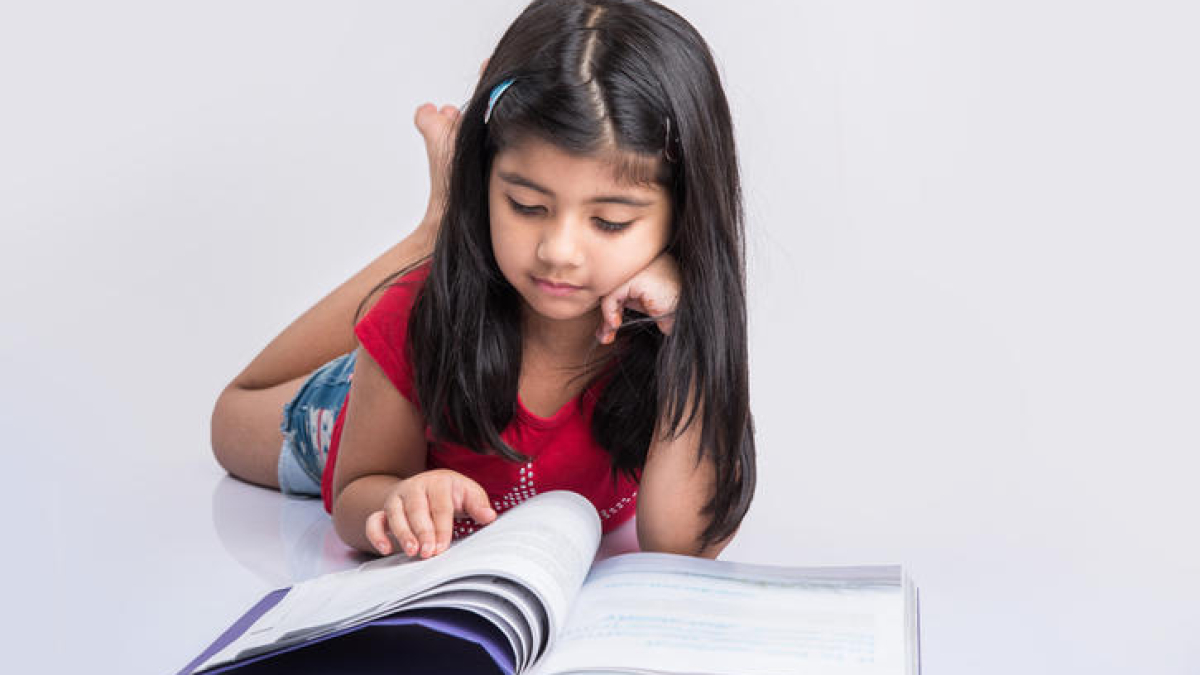
As adults, we have come to understand the importance of reading in our lives. Almost all parents realize that their children need to read for better growth and development. And hence they give a lot of importance to the literacy learning that their child receives from their preschool. As much as it is fair, the entire exercise of reading cannot, or rather should not be limited to an academic environment. Parents of toddlers don’t need to wait till the child reaches the ‘reading age’. Instead, they can familiarize their little ones to the art of reading from their infancy stage, and make it a part of their child’s life.
Importance of reading
There’s a famous saying by Dr. Seuss which goes as, “The more you read, the more things you will know. The more that you learn, the more places you’ll go.” Even though the significance of this statement is quite difficult to comprehend for young minds, it is upon the parents to drive their child towards learning and exposing their minds to new ideas and all that the world has to offer. Helping your child to develop pre-reading skills is one of the best things a parent can do.
Reading is the first step to learning
Introducing the art of reading in your child’s life can be effectively done through audio-visual interaction, much before they can learn to read themselves. In fact, research says, that the ideal place for parents to start reading out to their child is soon after birth. Orienting them gradually with reading at home, creates a mental comfort for the tender minds, which eventually makes learning to read easier for them when they start on their own.
Language and vocabulary development
To help with language development of your child, it is important for you to interact with them and expose them to language that they would speak in. Experts believe that parents can start building their child’s vocabulary by reading out new words and phrases to them. Pre-reading skills contribute to language development through exposure to a wide vocabulary of words, expressions, sentence structures and so on. Reading out and repeating the words and sentences in the most interactive manner will allow children absorb, even if they cannot speak. When they start reading, their brain would automatically relate to those words which they have been read out to.
It is important for them to recognize how words are made up of smaller sounds or phonemes. Actions like clapping for syllables, rhyming, and creating sounds for sounding words, can help your child identify the word or the letter they hear. By hearing and seeing your actions, children combine the phonemes and form words and phrases, which is the first step to language development. This helps develop their ‘phonological awareness’ which leads them to be successful in literacy learning when they start preschool. Phonological understanding in children is also critical for reading and writing as they grow up. And reading is a great platform to make them aware of phonetics.
Reading can be motivational
How to make reading a motivational activity? The way to do this is to make the reading experience full of joy and wonder. Because when children find anything joyful or intriguing, they enjoy it more and find the activity motivating. It creates energy for them. Learning is more meaningful and effective when children are stimulated and inspired. Children whose parents read out to them from infancy and who themselves enjoy the act of reading, are more likely to have better pre-reading skills and are more motivated to read, as opposed to those who have not experienced being read to.
Instilling pre-reading skills in your child
To instill good reading habits and nurture pre-reading skills in your toddlers, here are a few things you could integrate into your child’s life:
Start from the start
At first, children are not able to read but can hear and remember things. So use that potential of your child by making them listen to nursery rhymes. And this exercise is most likely to be effective if you sing out yourself to your little one. The more animated you can be, the more fun it is for your child.
Read out loud
Extending from our previous point of how children can remember from hearing much before they can read, it is essential to make sure that your voice is audible when you read out to you child. Research also shows that reading out loud can increase the brain capacity of children with respect to linguistic skills.
Make the reading activity a special one
Making the entire exercise of reading a special thing to do in the day, or some days of the week can make it more enjoyable for your child. A classic example followed traditionally is the ritual of ‘bedtime stories’. Similarly, you could make going to your neighborhood library or children’s bookstore a singular activity, so your child relates it to reading. Perhaps a Sunday morning picnic in the park with some swing time and some reading time. Or call your child’s friends over for a story-telling session, so they get to listen to stories with their friends. A reading ritual can bring motivation and make your child look forward to that ‘special time’
Integrate simple questions and answers
While you read out a story or pronounce words, create an interactive session with your child by introducing questions and answers. With infants, you might answer the questions yourself. With preschoolers, you could instigate them to give the answer. Always remember to ‘ask’ and not ‘grill’.
On a parting note…
Learning is a complex process for children. For them, to listen, comprehend and process new words every day is a magnanimous task and requires multiple skills at the same time. Every child develops these skills gradually. While some children are fast learners, others might take time. Every child is unique and has their own learning curve. As a parent, you need to be doubly patient with your child and enjoy the journey yourself.